If you have been practicing mindfulness for any length of time, you have likely encountered the paradox of effort. The more you try to be present, the more elusive presence becomes. You sit down to meditate and immediately your mind is off to the races. The Enso Sensory 128 Hz tuning fork offers a way out of this frustrating loop, and experienced mindfulness practitioners are taking notice. Unlike a meditation that asks you to generate awareness from within, the tuning fork provides an external anchor that your mind can rest on without trying so hard. The sound is always there, always predictable, always fading at the same rate. This consistency becomes a kind of training wheels for attention. Over time, your mind learns to stabilize on the tone, and that stabilization carries over into silent sitting as well.
Why Seasoned Meditators Are Adding the 128 Hz Fork to Their Toolkits
You might think that experienced meditators would have no need for a tool like a tuning fork. After all, they have spent years developing their ability to focus. Yet many of the most dedicated practitioners I know have enthusiastically added the Enso Sensory 128 Hz fork to their daily routines. Here is why. Even advanced meditators have days when their minds are simply too agitated to settle. On those days, the tuning fork acts as a gracious helper. It offers something so simple and so compelling that the mind cannot help but follow. Once the mind has caught onto the sound, the meditator can then let go of the fork and rest in the silence that follows. The fork becomes a bridge between a scattered mind and a settled one. It is not a crutch. It is a tool, just as a cushion or a meditation bench is a tool.
Deepening Body Awareness Through Vibrational Tracking
Mindfulness of the body is a core practice in many traditions, but it can be surprisingly difficult. You are asked to feel your breath, your heartbeat, the temperature of your skin. Yet for many people, especially those who have experienced trauma or chronic stress, the body feels numb or full of static. The Enso Sensory tuning fork changes this by giving you something specific to feel. When you hold the vibrating stem against your palm, your chest, or your forehead, you are feeling a very clear, very distinct sensation. As you practice tracking that vibration from its strongest point to its faintest whisper, you are training your interoceptive awareness—your brain's ability to sense the internal state of your body. This skill then generalizes. You become better at feeling your breath, your heartbeat, and the subtle signals that tell you when you are tired, hungry, or stressed before those states become overwhelming.
Using the Tuning Fork to Mark the Beginning and End of Sitting
One of the most practical ways mindfulness practitioners are using the Enso Sensory 128 Hz fork is as a ceremonial marker. The sound signals to your mind that something important is beginning. Before you sit down for your formal meditation practice, strike the tuning fork once. Listen as the sound fills the space around you. Then set the fork down and begin your sitting. At the end of your practice, strike the fork again. Listen once more. This second strike closes the container, telling your brain that the formal practice is over and you are returning to the rest of your life. This simple bookending has profound effects. It prevents the feeling of being pulled out of meditation abruptly. It also builds a conditioned association between the sound of the fork and the state of meditative calm. Eventually, just hearing the fork can begin to shift your nervous system.
The Ren Zen Garden as a Walking Meditation Companion
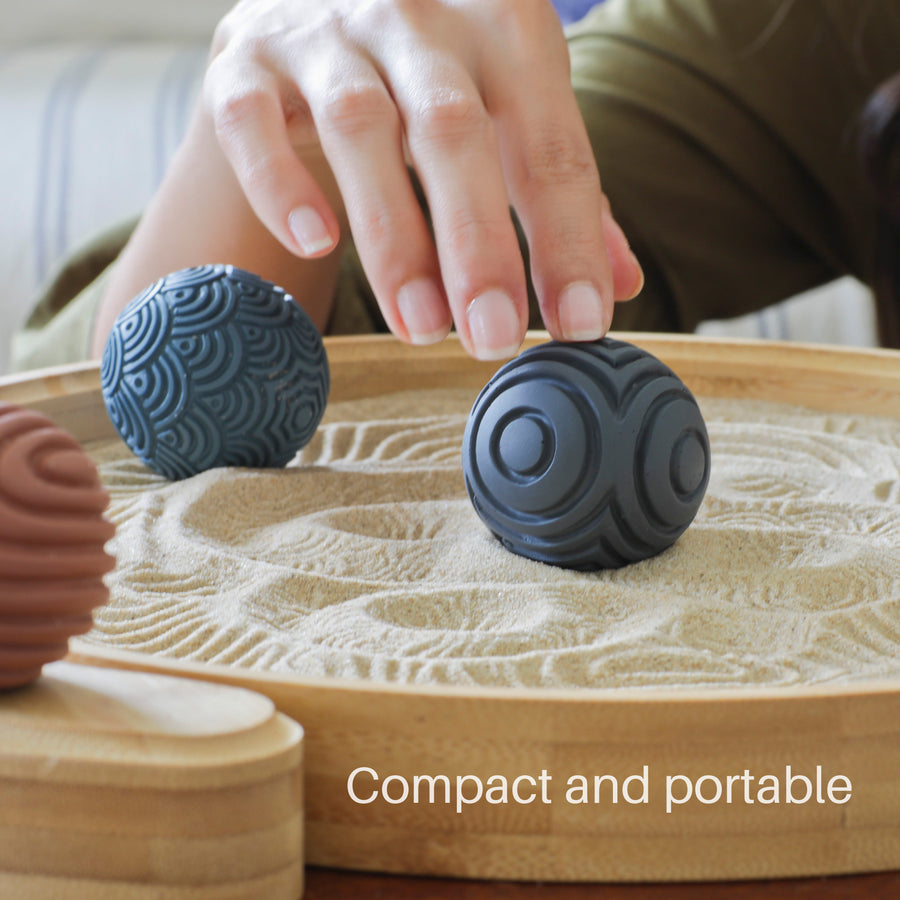
Walking meditation is a beloved practice in Zen traditions, but not everyone has a garden path or a quiet hallway to walk in. The Enso Sensory Ren Zen Garden offers an alternative. Place the garden on a low table at waist height. Strike the tuning fork and let it ring as you slowly move the rake through the sand in time with your breath. Inhale as you lift the rake. Exhale as you draw it through the sand. This becomes a seated walking meditation, a way to practice the same qualities of attention and intention without needing to physically move through space. Many practitioners find that this form of meditation is actually easier to sustain for longer periods because the visual feedback of the sand patterns gives the mind something satisfying to witness. You are not just being present. You are creating something beautiful with your presence.
Integrating Sound and Silence in Your Practice
The relationship between sound and silence is at the heart of many mindfulness traditions. You cannot have one without the other. The Enso Sensory tuning fork makes this relationship tangible. When you strike the fork, you hear a clear, pure tone. Then you hear it begin to fade. Then you hear the silence that was there all along, now suddenly obvious. This progression from sound to silence is a direct teaching. It shows you that silence is not the absence of something. It is the presence of everything else. Practitioners who use the fork regularly report that their silent meditations become deeper. They are no longer afraid of silence or bored by it. They have learned, through countless repetitions of the tuning fork's fade, that silence is rich and alive. It is simply waiting for you to listen.
Transforming Distraction into the Path
One of the most advanced teachings in mindfulness is that distraction is not the enemy. It is simply more fuel for the practice. The Enso Sensory tuning fork embodies this teaching perfectly. You will get distracted while listening to the fork. Your mind will wander to what you need to buy at the grocery store or what your coworker said yesterday. That is not a failure. That is the practice. Each time you notice the distraction and gently return your attention to the fading tone, you are building the muscle of mindfulness. The fork does not judge you for wandering. It simply continues to ring, waiting patiently for your return. Over time, you may find that you return more quickly. The gaps between wandering and noticing grow shorter. This is progress, even if it does not feel like it. And it is progress that happens whether you are using the fork or sitting in silence. The training transfers. That is the gift the Enso Sensory 128 Hz tuning fork offers to mindfulness practitioners at every level.


Share this page with your family and friends.